Density functional theory (DFT) is the workhorse of computational chemistry because it offers useful accuracy at a cost that scales to real molecules and materials. It is not a single method, though. Every calculation rests on a choice of functional and basis set, and a poor choice can move a reaction barrier by more than the effect being studied. This article gives a practical route through those choices.
What DFT approximates
Kohn–Sham DFT replaces the many-electron wavefunction with the electron density, obtained from a set of one-electron orbitals. The theory is exact in principle. In practice one term, the exchange–correlation energy, has no known exact form and has to be approximated. The functional is that approximation. The basis set is the finite set of functions used to expand the orbitals. The two sources of error are largely independent and should be controlled separately.
Jacob's ladder
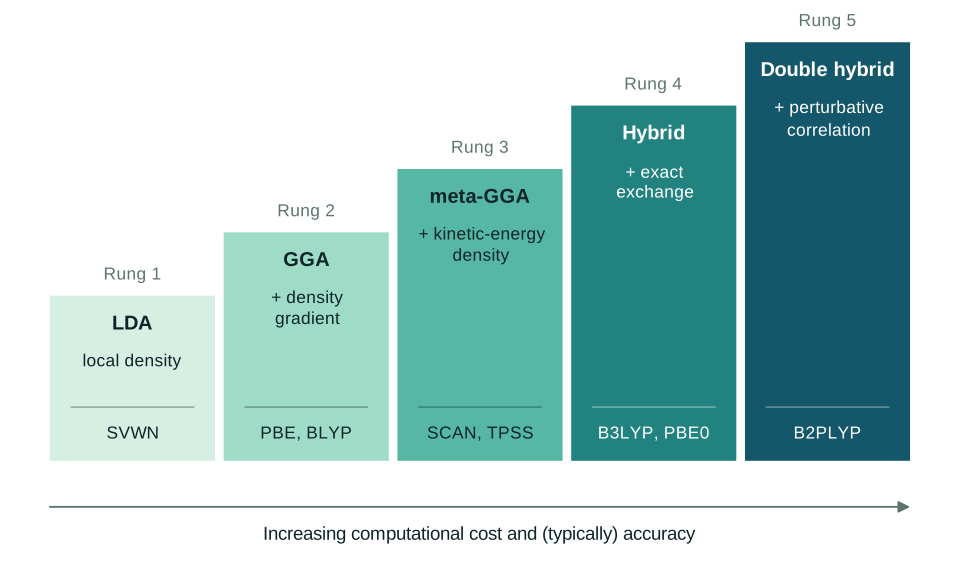
Perdew's "Jacob's ladder" sorts functionals by the ingredients they use. Each rung adds information and, usually, cost.
| Rung | Added ingredient | Well-known examples |
|---|---|---|
| LDA | Local density only | SVWN |
| GGA | Density gradient | PBE, BLYP, BP86 |
| Meta-GGA | Kinetic-energy density | TPSS, SCAN, r2SCAN |
| Hybrid | A fraction of exact (Hartree–Fock) exchange | B3LYP, PBE0, M06-2X, ωB97X-D |
| Double hybrid | Perturbative (MP2-like) correlation | B2PLYP, DSD-PBEP86 |
GGAs are inexpensive and give good geometries, but they tend to underestimate reaction barriers, a consequence of self-interaction error. Hybrids reduce that error and are the usual choice for molecular thermochemistry and kinetics. Range-separated hybrids such as ωB97X-D and CAM-B3LYP vary the exact-exchange fraction with inter-electron distance, which helps with charge-transfer problems. Double hybrids are often the most accurate DFT option for main-group chemistry, at a higher cost and with a stronger basis-set dependence.
Climbing the ladder improves accuracy on average, not in every case. Transition-metal complexes, spin-state energetics and systems with strong static correlation are frequent exceptions. In those cases the fraction of exact exchange can change the answer qualitatively.
Dispersion corrections
Standard functionals do not describe long-range London dispersion. Uncorrected, they underbind non-covalent complexes and distort conformational energies, and the error grows with system size. Grimme's D3 correction (normally with Becke–Johnson damping) and its successor D4 add this contribution at negligible cost. Some functionals instead include a non-local correlation term, as ωB97X-V and ωB97M-V do.
Include a dispersion correction in every calculation unless the functional already contains one. There is rarely a good reason to leave it out.
Basis-set families
- Pople sets such as 6-31G(d) and 6-311+G(d,p) are long established and still common in organic chemistry. They are compact, but less systematically constructed than newer families.
- Dunning correlation-consistent sets, cc-pVXZ with X = D, T, Q and beyond (and the aug- versions with diffuse functions), converge systematically towards the complete-basis-set limit. They are the natural choice for wavefunction methods such as CCSD(T).
- Karlsruhe def2 sets (def2-SVP, def2-TZVP, def2-QZVP) cover most of the periodic table consistently, with matching effective core potentials for heavier elements and auxiliary sets for density fitting. They are a sound default for DFT.
DFT energies converge faster with basis-set size than correlated wavefunction energies. As a guideline, a double-zeta set is adequate for exploratory geometries, and a triple-zeta set is the working standard for energies. Add diffuse functions for anions and weakly bound complexes.
Basis-set superposition error
When two fragments form a complex, each can use the other's basis functions to lower its own energy. The complex is therefore described with a better basis than the separated fragments, and the binding energy is overestimated. This is basis-set superposition error (BSSE). The Boys–Bernardi counterpoise correction removes most of it by computing each fragment in the full basis of the complex, with the partner's atoms present as "ghost" centres carrying basis functions but no nuclei or electrons.
BSSE shrinks as the basis grows. It is substantial at double-zeta level and usually small at quadruple-zeta. For binding energies with small or medium basis sets, apply the correction or at least report its size.
Sensible defaults
Geometries are less sensitive to the level of theory than energies, so a two-step protocol is standard:
- Optimise the geometry and compute vibrational frequencies with a dispersion-corrected GGA, meta-GGA or hybrid and a double- or triple-zeta basis.
- Compute a single-point energy at that geometry with a hybrid or double hybrid and a larger basis, triple-zeta with diffuse functions or quadruple-zeta.
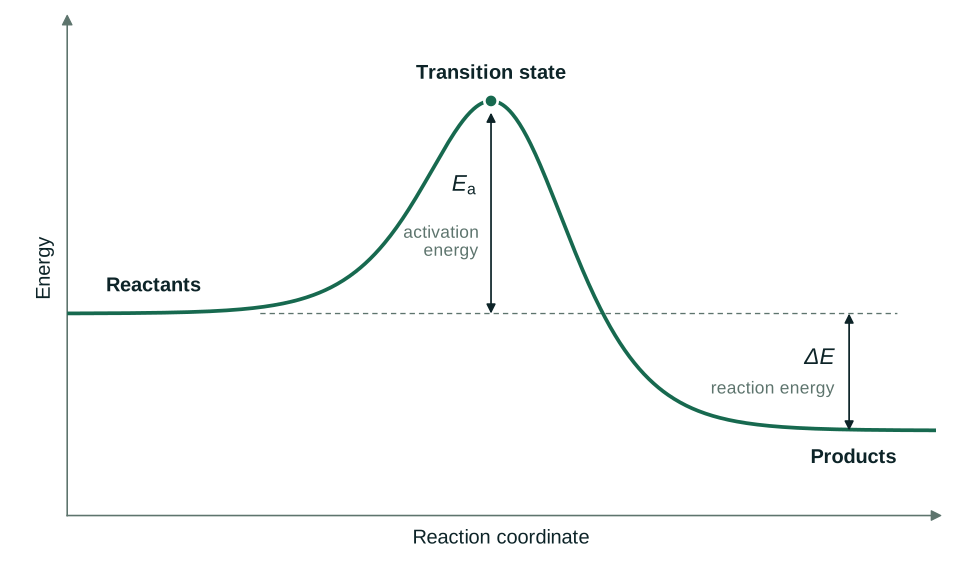
The frequency calculation is essential. It confirms that a minimum has no imaginary frequencies and that a transition state has exactly one, and it supplies the zero-point and thermal corrections needed for free energies. For chemistry in solution, add an implicit solvation model consistently in both steps.
Benchmark before you trust
No functional is best for everything, and published rankings are averages over test sets that may not resemble your chemistry. Before a production study, take a small model of your system and compare candidate functionals against a higher-level reference, typically CCSD(T) near the basis-set limit or a local-correlation variant for larger molecules, or against reliable experimental data. Accuracy matters here: at room temperature an error of about 5.7 kJ/mol (1.4 kcal/mol) in a barrier changes the predicted rate by a factor of ten.
What the calculations deliver
Typical outputs are optimised geometries of reactants, products, intermediates and transition states; reaction and activation energies; and vibrational frequencies, which give infrared spectra and thermochemistry. Orbitals, charge distributions and spectroscopic properties follow from the same calculations.
How CFD Pro can help
CFD Pro provides computational quantum chemistry services alongside its CFD work, supporting clients from problem definition through to verified results and reporting. If you have a mechanism, a material or a set of candidate molecules to evaluate, send us a project brief.