REPRESENTATIVE STUDY · Energy · Structures
Predicting vortex-shedding loads on a bluff structure
An unsteady study that finds the shedding frequency and fluctuating forces on a cylindrical structure, and checks how close they sit to its natural frequency.
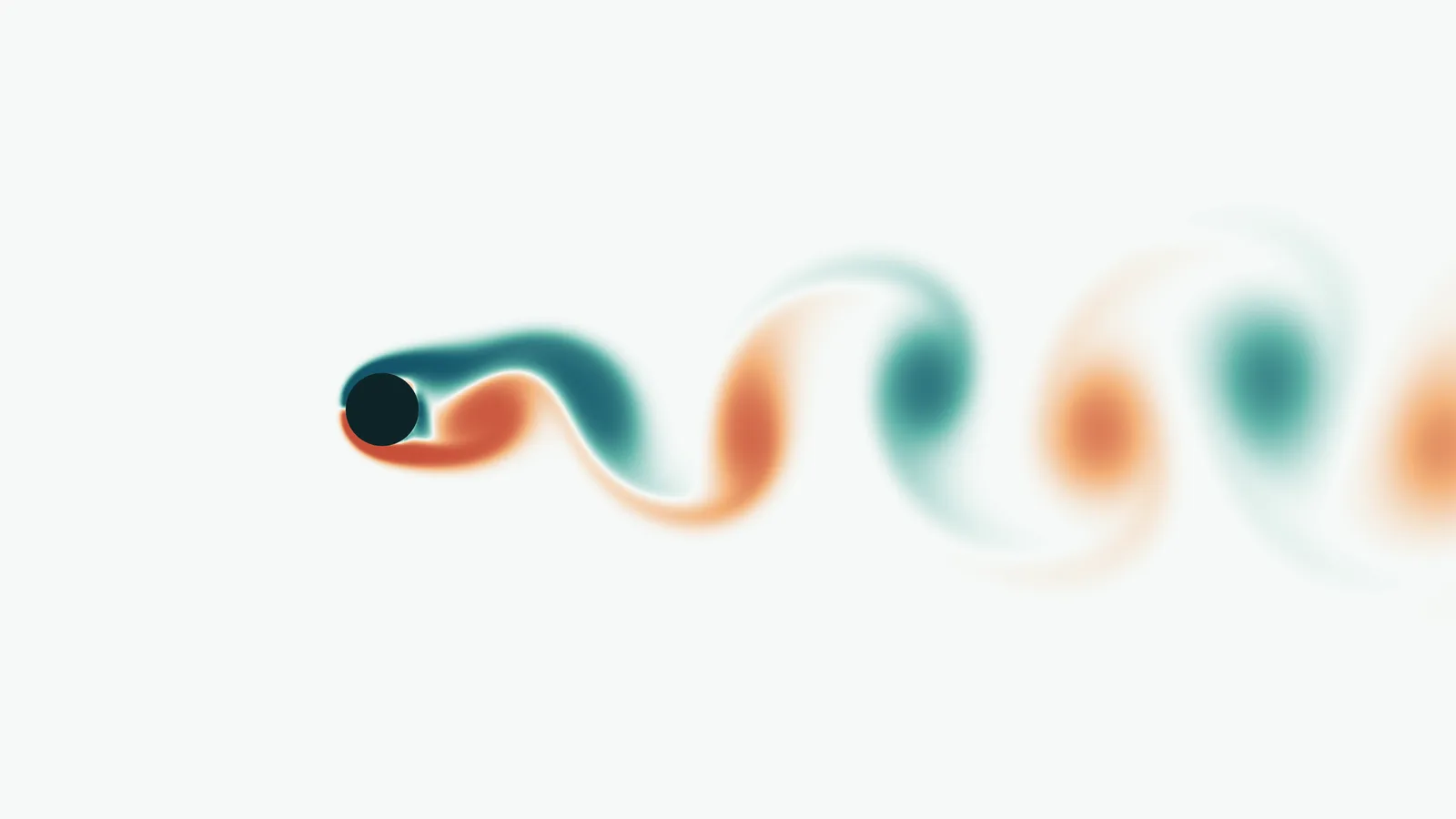
Flow past a chimney, riser or sensor probe sheds vortices alternately from each side. If the shedding frequency meets a natural frequency of the structure, a steady breeze becomes a fatigue problem.
The question
A slender cylindrical structure sits in a cross-flow over a range of speeds. The structural team needs the shedding frequency at each speed, the mean drag, and the amplitude of the fluctuating lift and drag, so they can judge the risk of resonance and decide whether suppression devices are needed.
The approach
A steady solution cannot answer this, because the quantity of interest is the unsteadiness itself. The flow is solved in time, with the time step chosen to resolve each shedding cycle with enough points, and run until the force histories settle into a repeating pattern. Where the wake is massively separated, a hybrid DES approach resolves the large structures that RANS would smear. We discuss the choice in RANS, LES or DES?
The lift and drag histories are then analysed in the frequency domain. The dominant peak gives the shedding frequency, which is reported as a Strouhal number so it can be compared with published data for similar shapes as a validation check.
What the study delivers
- Shedding frequency and Strouhal number across the speed range
- Mean and root-mean-square force coefficients
- The speeds at which shedding approaches the structure’s natural frequencies
- Animations of the wake, and a comparison with strakes or a shroud if suppression is needed
Why it matters
Vortex-induced vibration is far cheaper to design out than to retrofit against. Knowing the frequencies and loads in advance lets the structure, its supports or its shape be adjusted while they are still drawings.
About this study. This is a representative example of how we approach this type of problem, shown with computed illustrative imagery. It is not a report on a specific client engagement.